Tuesday, March 17, 2009

"Now, having shrunk, firms may decide to stay smaller. Rather than opening new offices in distant cities or hiring experts in special building types, they may rely increasingly on alliances with other firms. And rather than adding full-time staff when work comes in, they may continue to hire temporary employees."

Recession Is Ravaging Architectural Firms
By DAVID W. DUNLAP
Published: Sunday, May 17, 1992

Monday, March 9, 2009

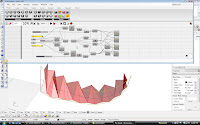
Pleated Developable-Curve Wall


the input is the two rail curves for the double curve surface.... the grasshopper script divides the surface into folded triangular pleats which do not contain any bending.


Saturday, March 7, 2009

CoffeeSleeve - grasshopper

here is my newest project: with Chris Ludwig, we plan to make screen wall using coffee sleeves... so as a way to learn mor about grasshopper, i'm also trying to construct the geometries/ movement relationships in grasshopper/rhino. above is the sleeve alone... below they are arrayed along "cables" or pulls, like a mini-blind. the idea is they pulls can control the entire array of sleeves (this section is a work in progress)


pull chords about the same length


pull chords drastically different. note how the coffee sleeve responds.


Friday, March 6, 2009

Parametric? vs. Generative? vs. Logical?


"Although I more or less agree with that definition my personal view of Generative Design is slightly different. For lack of a better example I'm going to go with DNA. In its raw state, DNA contains all of the instructions by which life can be created. It will dictate the growth of cells as well as the type/characteristics of cells. Theoretically you could clone someone from their DNA and get an exact "copy" of that person (remember Dolly?). However, the end result of that clone would not be an exact copy. Why? The growth of cells is not dictated solely by DNA, but also by its interactions with its surroundings. Since the clone invariably develops in conditions that were different from the "source being" there will always be a difference between the two.


To me, this is the characteristic of generative design. Its not just a product of the parameters that generate it, but of the conditions that surround and interact with it. Even within that definition, there's a very thin line that separates parametric design from generative design, since both rely on defining their operations through external values. That thin line, to me, is parametric design being generated by a singular reference to an outside piece of data and generative design being generated by a multitude of references an some interpretation of those references in an interconnected manner.


I've moved towards defining GH as a Logical Modeler rather than parametric or generative. The main reason is that most parametric modelers rarely focus on the link between parameters as an artifact of their process. Because of this, their process, though parametrically based, is still embedded within model itself, which is certainly fine. GH does not operate in this manner. The creation of a GH definition is more of a representation of the logical steps used to create a given output, where as with parametric modelers, the representation of the inheritance of all parameters is not nearly as evident. Considering the control, amount of information that is immediately available by looking at a definition, and the interaction with those logical steps I would certainly argue that THAT is an extremely valuable aspect of the GH process. I could possibly argue that the GH definition itself is more valuable than the output it creates.

As to the Generative capabilities of parametric modelers and GH, it all depends on how you structure the interactions with external data. A 1 to 1 relationship between a value and an output is more parametric in my book, where the interaction between a multitude of values is more of a generative approach.
Just my 2 cents "
Best, Damien

Monday, February 23, 2009

RhinoBook


http://www.rhinoacademie.com/index_GB.html
(rhino 4.0 book)


http://blog.rhino3d.com/
(all rhino news, all the time)

http://www.designalyze.com/category/rhino/grasshopper/

(designanlyze.... cool grasshopper vb.net tutorial)


http://groups.google.com/group/grasshopper3d/topics?hl=en&gvc=2
(new grasshopper disscussion posts)

http://jarek-rhinoscripts.blogspot.com/
(very cool tools)

http://www.visualarq.com/2008/07/introduction_16.html
(3rd Party Rhino Plug-in. (beta version) begins to perform BIM type architectural element creation)


Thursday, January 1, 2009

Jeffrey Inaba – whom BLDGBLOG interviewed a few years ago – predicts "a domino effect of operational failures that will to lead systematic breakdowns of infrastructure and services in [the] urban center." Unperturbed, he points us to Barack Obama's Urban Prosperity plan. Inaba writes (emphases added):

"Though it is packaged as a recovery plan it is really a new cities plan. In its most immediate sense it seeks to improve the depressed economy through urban development: to prop up markets by creating jobs to build infrastructure, transportation systems, public facilities like libraries and schools and to implement clean building technologies. But the plan is more ambitious and far reaching. It does more than try to improve cities as a means to an end, it aims to transform what cities are. Instead of calling for maintenance repairs and incremental upgrading, it looks to make a new kind of living environment where cities operate efficiently at a regional (rather than municipal) scale with advanced forms of collective transportation and sustainable infrastructure systems. The declaration of such a plan in itself expands the horizon of possibilities for what we as architects can design, and more importantly, it offers a historically unique opportunity for a developed nation to have a second chance to make a smart form of city. Hopefully, it won’t come down to an additional series catastrophic of events to realize such a plan. But it probably will."


From my Thesis -

The project situates itself in a seldom explored area for architects; the meaning, function, aesthetics and organization of infrastructure. This allows for a re-conceptualization of rail travel and infrastructure, which in turn, offers the possibility to enhance the existing interstate highway system and bring mass transit back into the American consciousness without dismissing American’s unique relationship with the automobile.


Thursday, September 11, 2008

Script: Terrain


This script creates boxes that vary in height in response to the curvature of a spline. Inputs are: field size, length and width; cell size, and proximity to spline. An option offers the boxes to remain flat (zero height) along the spline. An output file is also created that displays the size, height and location of each box created.

Summer Work II - First Financial Center Canopy/Lobby

Another summer project with Joel Agacki - Striegel - Agacki Studio.


Summer Work I - Felske Residence

One of several summer projects: New house in East Troy, WI. Designed with Joel Agacki, Striegel - Agacki Studio.


Monday, May 12, 2008